Online Couples Therapy: How the Gottman Method can Help
Relationships can be one of the most meaningful parts of life. They can also be one of the most painful.
Many couples come to therapy feeling disconnected. You may argue about the same things over and over. You may feel lonely even when you are together. One partner may want more closeness while the other shuts down. Sometimes the relationship starts to feel more like a source of stress than a source of comfort.
The good news is that relationships can change.
Online couples therapy gives you a chance to understand what is happening between you. It will also give you new ways to communicate, reconnect, and solve problems together. One of the most researched and effective approaches for couples therapy is the Gottman Method (Gottman & Gottman, 2015).
At Virtual CBT Psychotherapy, Crystal Pacheco, RSW, MSW provides online couples therapy across Ontario. She uses evidence-based approaches like the Gottman Method. Crystal has a level 1 certification in the Gottman Method for Couples Therapy. Therapy is not about deciding who is right or wrong. It is about helping both partners understand each other and build a stronger relationship.
Why couples get stuck
Most couples do not struggle because they do not love each other.
They struggle because they get caught in patterns.
For example:
One partner criticizes.
The other becomes defensive.
Someone shuts down.
The conversation ends without resolution.
The same argument happens again next week.
Over time, these patterns create distance. Small conflicts start to feel bigger. Partners begin to expect disappointment.
The Gottman Method focuses on these interaction patterns. Instead of blaming one partner, it helps couples understand their cycle. The Gottman Method teaches practical skills to make changes together (Gottman & Gottman, 2015).
What is the Gottman Method?
The Gottman Method is a structured approach to couples therapy based on decades of research with thousands of couples.
Drs. John and Julie Gottman studied what helps relationships succeed and what predicts relationship distress. Their research found that healthy relationships are built on friendship, trust, respect, and effective conflict management (Gottman & Gottman, 2015).
In therapy, you learn how to:
Improve communication
Manage conflict without damaging the relationship
Rebuild emotional connection
Increase understanding
Strengthen trust and commitment.
The goal is not to end all conflict. Every couple has disagreements. The goal is to handle those disagreements in a way that brings you closer rather than further apart.
What happens in online couples therapy?
Many couples worry that online therapy will feel less personal than in-person therapy.
In reality, many people find online couples therapy easier and more comfortable.
You can join from home. You do not have to drive across the city. Parents do not need to arrange childcare. Busy professionals can often fit sessions into their schedules.
The first few sessions usually focus on understanding your relationship. In the beginning of therapy, the couples therapist will explore:
Your relationship history
Current challenges
Communication patterns
Strengths
Goals for therapy
This assessment helps identify the areas that need the most attention.
From there, therapy becomes practical. You will learn skills, practice them during sessions, and apply them between sessions.

The communication problem most couples miss
Many couples believe their problem is communication.
Often, the deeper problem is emotional connection.
For example, imagine one partner says, “You never help around the house.”
The other hears, “You are failing.”
A defensive argument begins.
The surface issue is chores. The deeper issue may be feeling unsupported, overwhelmed, or unimportant.
The Gottman Method helps couples slow down these conversations and understand the emotions underneath them.
When partners feel heard and understood, problem-solving becomes much easier (Gottman & Gottman, 2015).
The four patterns that damage relationships
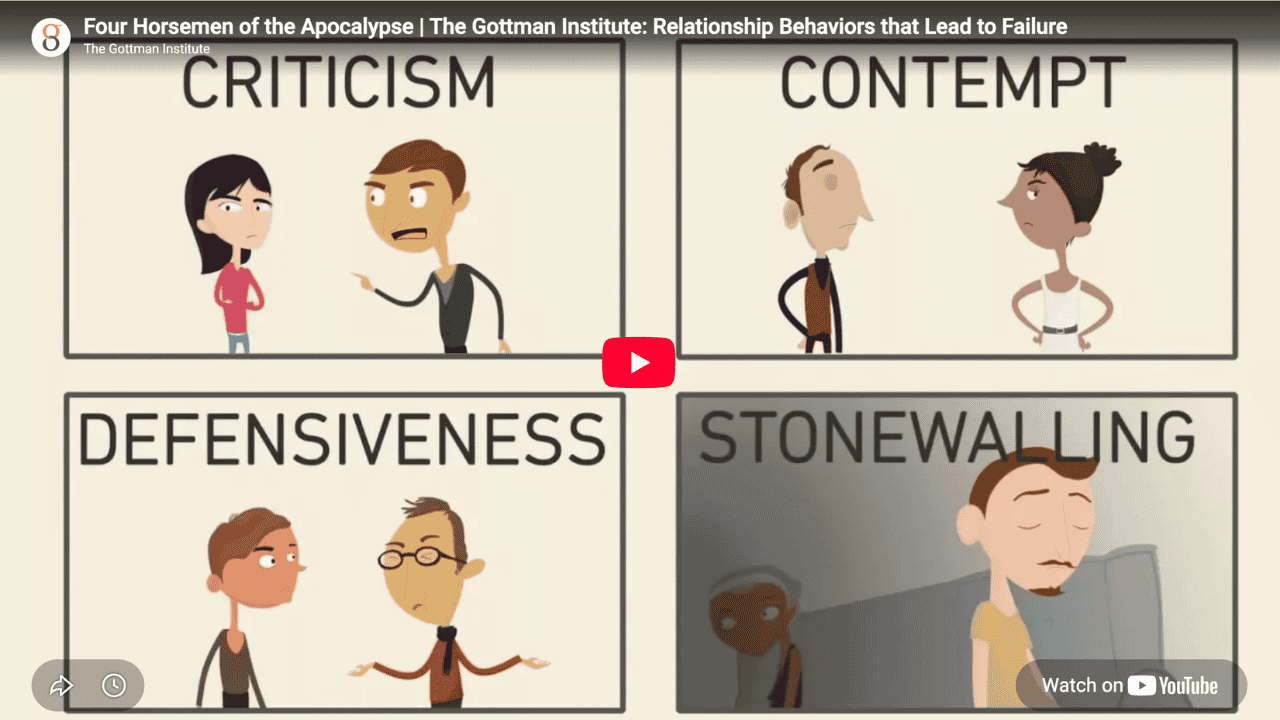
The Gottmans identified four communication patterns that predict relationship distress.
Criticism
Attacking your partner’s character instead of describing a specific concern.
Defensiveness
Protecting yourself instead of listening.
Contempt
Sarcasm, insults, eye-rolling, or disrespect.
Stonewalling
Shutting down emotionally or withdrawing from the conversation.
These patterns can become automatic.
In online couples therapy, you learn how to recognize these patterns. You then learn to replace them with healthier responses (Gottman & Gottman, 2015).
Source: The Gottman Institute
Rebuilding friendship and trust
One of the most important parts of the Gottman Method is strengthening the friendship within the relationship.
This may sound simple, but it is powerful.
Many struggling couples spend most of their energy discussing logistics, parenting, finances, or conflict.
They stop asking each other questions.
They stop sharing small moments.
They stop turning toward each other emotionally.
Therapy helps rebuild these daily connections.
This might include:
Expressing appreciation
Responding to each other’s emotional bids
Increasing affection
Creating shared rituals
Spending meaningful time together.
Research suggests that these positive interactions help strengthen relationship satisfaction and resilience (Gottman & Gottman, 2015).
Can online couples therapy really work?
Yes. Research suggests that couples therapy can improve relationship satisfaction and reduce relationship distress for many couples (Lebow et al., 2012).
Online therapy has also become an effective option for many people.
For couples, virtual therapy often reduces barriers such as travel time, scheduling difficulties, and access to specialized therapists.
The most important factor is not whether therapy happens online or in person.
It is whether both partners are willing to engage in the process and practice new ways of interacting.
Is couples therapy only for relationships in crisis?
No.
In fact, many couples benefit from therapy before their relationship reaches a crisis point.
Couples often seek therapy when they notice:
Increasing arguments
Emotional distance
Loss of intimacy
Parenting conflicts
Trust issues
Major life transitions
Communication problems
Early intervention is often easier than waiting until resentment has built for years.
Think of couples therapy as relationship maintenance, not just relationship repair.
What if my partner is hesitant?
This is one of the most common concerns.
Many people worry that therapy will become a place where they are blamed.
A good couples therapist does not take sides.
The focus is on understanding the relationship system.
You can tell your partner that therapy is not about proving who is right.
It is about learning a better way to communicate and reconnect.
Many reluctant partners become more comfortable once they experience a structured, respectful, and practical approach.
What makes the Gottman Method different?
The Gottman Method combines warmth with structure.
The therapist helps couples feel heard while also providing clear tools they can use outside of therapy.
Our approach to couples therapy is evidence-based, including the Gottman Method. In other words, we use therapies that have a proven history.
Sessions are collaborative.
You will not be judged.
You will learn skills that you can continue using long after therapy ends.
7 tips from online couples therapy to strengthen your relationship
Small changes often make a bigger difference than grand gestures. The Gottman Method focuses on the everyday moments that build trust and respect (Gottman & Gottman, 2015). Here are seven practical strategies that many couples can start using today.
1. Start difficult conversations with gentleness
How you begin a conversation often determines how it ends.
Instead of saying, “You never listen to me,” try, “I’ve been feeling disconnected, and I’d like us to talk.”
A gentle start helps your partner stay open instead of becoming defensive. Research shows it can reduce conflict escalation (Gottman & Gottman, 2015).
2. Listen to understand, not to win
During an argument, many people focus on preparing their next response.
Try slowing down.
Ask questions. Reflect back what you heard. Check if you understood correctly.
Feeling understood is one of the strongest predictors of connection in a relationship (Gottman & Gottman, 2015).
3. Turn toward each other in small moments
Ordinary moments build healthy relationships.
When your partner shares a story, asks for help, or reaches for a hug, those are opportunities for connection.
Responding with interest, warmth, or attention helps strengthen intimacy over time (Gottman & Gottman, 2015).
4. Express appreciation every day
Couples often notice what is missing more than what is working.
Make it a habit to express appreciation.
Say thank you.
Notice effort.
Acknowledge kindness.
Gottman’s research suggests that stable relationships have many more positive interactions than negative ones (Gottman Institute, n.d.).
5. Take a break when emotions become overwhelming
Not every conversation should continue in the heat of the moment.
If you notice your heart racing, your voice rising, or your mind shutting down, take a 20-30 minute break.
Use that time to calm your body, not to rehearse arguments.
Then return to the conversation when both of you are more regulated (Gottman & Gottman, 2015).
6. Focus on the problem, not your partner’s character
There is a big difference between a complaint and a criticism.
Instead of saying, “You’re so selfish,” try, “I felt hurt when we made that decision without talking about it first.”
This keeps the conversation focused on a specific issue rather than attacking your partner’s character.
7. Protect your friendship
One of the most overlooked relationship skills is friendship.
Ask your partner about their day.
Learn about their worries.
Celebrate their successes.
Laugh together.
The Gottman Method emphasizes that strong relationships are built on a foundation of friendship, admiration, and emotional connection (Gottman & Gottman, 2015; Gottman Institute, n.d.).
These tips are not about being a perfect couple. They are about creating a relationship where both partners feel heard, respected, and safe. If these changes feel difficult to make on your own, online couples therapy can help you practice these skills with guidance and support.
Frequently asked questions (FAQ): online couples therapy
How does online couples therapy work?
You and your partner meet with your therapist through secure video sessions. Therapy focuses on communication, conflict management, emotional connection, and relationship goals. Many couples find online therapy convenient and effective.
Is online couples therapy as effective as in-person therapy?
For many couples, yes. Research suggests that couples therapy can improve relationship satisfaction and reduce relationship distress. And virtual therapy can increase access to evidence-based treatment (Lebow et al., 2012).
What is the Gottman Method in online couples therapy?
The Gottman Method is a research-based approach that helps couples improve communication, manage conflict, rebuild trust, and strengthen emotional connection. It is one of the most well-known evidence-based approaches for couples therapy (Gottman & Gottman, 2015).
How long does online couples therapy take?
The length of therapy depends on your goals and the challenges you are facing. Some couples attend for a few months, while others choose longer-term work to strengthen their relationship.
Can online couples therapy help after repeated arguments?
Yes. Many couples seek therapy because they feel stuck in the same conflict cycle. The Gottman Method helps identify these patterns and teaches practical skills to interrupt them and communicate more effectively.
Take the first step toward a stronger relationship
You do not have to keep having the same painful conversations.
You do not have to figure this out alone.
Relationships can heal when both partners have the opportunity to feel heard, understood, and supported.
If you are looking for online couples therapy in Ontario, Crystal Pacheco offers compassionate, evidence-based therapy using the Gottman Method to help couples improve communication, rebuild trust, and reconnect.
Book a free 15-minute call today and take the first step toward a healthier, more connected relationship.
Written by Crystal Pacheco, RSW, MSW. Gottman Level 1 Therapist for Couples
References
Gottman, J. M., & Gottman, J. S. (2015). 10 principles for doing effective couples therapy. W. W. Norton & Company.
Lebow, J. L., Chambers, A. L., Christensen, A., & Johnson, S. M. (2012). Research on the treatment of couple distress. Journal of Marital and Family Therapy, 38(1), 145–168.